
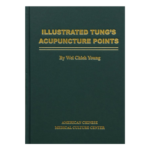
 | Illustrated Reference · Tung's Acupuncture Quick Facts Author Dr Wei-Chieh Young Pages 140pp, hard-cover Language English Publisher American Chinese Cultural Center Edition 2nd edition, 2016 ISBN 978-1-943744-02-2 Accurate point location is foundational to effective acupuncture — and in Tung's system, where points lie largely outside the classical meridian structure, a reliable visual reference is especially valuable. Illustrated Tung's Acupuncture Points by Dr Wei-Chieh Young fills that gap directly. Featuring over 200 colour photographs, the book provides clear visual references for each point — organised by body area rather than point family, making it straightforward to use in a clinical setting. It is designed as a practical companion, equally useful to those new to Tung's acupuncture and to experienced practitioners wanting a reliable desk reference. What the book covers 01 Over 200 colour photographs providing precise visual location guidance for Tung's acupuncture points 02 Points organised by body area — fingers, hands, arms, legs, head, back and chest — for easy clinical reference 03 Clear anatomical references to support accurate and consistent point application in practice 04 Coverage of the full range of Tung's point locations as taught and documented by Dr Wei-Chieh Young 05 A compact, hard-cover format designed for everyday use alongside clinical practice Who this is for Suitable for practitioners at all levels working with Tung's acupuncture — whether building familiarity with the point system for the first time or wanting a reliable, photo-based reference to support established clinical practice. Works well alongside Lectures on Tung's Acupuncture: Therapeutic System for those seeking both the theoretical grounding and the practical atlas. | |
 | Clinical Study · Tung's Acupuncture Quick Facts Author Dr Wei-Chieh Young Pages 298pp, flex cloth-bound Language English Publisher American Chinese Cultural Center Edition 6th print, 2016 ISBN 978-0-9779026-4-4 Knowing where a point is and understanding what it does are two distinct things. Lectures on Tung's Acupuncture: Points Study bridges that gap — going beyond location to explore the mechanisms, characteristics and clinical logic behind each of Master Tung's extraordinary points. Building on Dr Wei-Chieh Young's earlier works, this volume provides a deeper and more systematic study of the point system itself. Organised by body area and illustrated throughout, it adheres closely to Master Tung's original teachings while drawing on Dr Young's decades of clinical experience — making it the most thorough English-language reference on Tung's points available. What the book covers 01 Detailed study of each point's location, characteristics and underlying mechanisms, as taught by Master Tung 02 Clinical applications for each point, grounded in Dr Young's extensive practice and scholarship 03 Points organised by body area — fingers, hands, arms, legs, head, back and chest — with clear illustrations throughout 04 The theoretical principles behind point selection, building a deeper understanding of why specific points are chosen 05 Expanded depth on the point system compared to earlier volumes, with richer clinical context throughout Who this is for Best suited to practitioners with some existing familiarity with Tung's acupuncture who want to deepen their understanding of the point system itself. Pairs naturally with Illustrated Tung's Acupuncture Points for visual reference and Lectures on Tung's Acupuncture: Therapeutic System for treatment application. | |
 | Clinical Reference · Tung's Acupuncture Quick Facts Author Dr Wei-Chieh Young Pages 267pp, soft-bound Language English Publisher American Chinese Cultural Center Edition 5th edition, 2017 ISBN 978-0-9779026-5-1 Tung's acupuncture occupies a distinctive place in Chinese medicine. Developed by Master Tung Ching-Chang and transmitted through a small circle of trusted students, it uses a system of points largely outside the classical meridian structure — points that have attracted significant clinical interest but require a different framework to understand and apply well. Lectures on Tung's Acupuncture: Therapeutic System draws on seminars delivered by Dr Wei-Chieh Young at Korean universities, transcribed and structured into a systematic clinical reference. Dr Young — one of the foremost Western authorities on Tung's acupuncture — covers point selection logic, treatment principles and the theoretical foundations that distinguish Tung's system from classical TCM acupuncture. What the book covers 01 The theoretical basis of Tung's acupuncture and its relationship to classical meridian theory 02 Point selection principles across a broad range of clinical presentations 03 Clinical applications spanning neurological, gynaecological and dermatological presentations 04 Practical guidance on integrating Tung's points with classical meridian-based techniques 05 Detailed clinical comparisons to support decision-making in practice 06 The distinguishing features of Tung's system set against classical TCM acupuncture methodology Who this is for This is a reference text for practitioners, not an introductory guide. It assumes a working knowledge of TCM acupuncture and builds from there — most valuable to those already in practice who want to extend their clinical range. | |
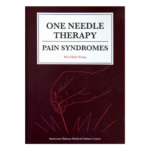 | Clinical Methodology · Pain Syndromes Quick Facts Author Dr Wei-Chieh Young Pages 360pp, paperback Language English Publisher American Chinese Cultural Center Edition 1st edition, 2018 ISBN 978-1-943744-05-3 Translated by Kitty Wong-Robertson Single-needle acupuncture represents a distinct and disciplined approach to clinical practice — one that demands precise diagnosis, confident point selection and a thorough command of acupuncture theory. One Needle Therapy: Pain Syndromes by Dr Wei-Chieh Young is a comprehensive guide to applying this approach across a wide range of pain presentations. Dr Young presents a systematic framework for approaching neurological and motor system conditions alongside common pain syndromes — from headaches and back pain to earaches and toothaches — explaining his point selection rationale in detail throughout. This is a book about clinical thinking as much as technique, helping practitioners develop the diagnostic clarity that single-needle work requires. What the book covers 01 The theoretical and diagnostic principles underpinning a single-needle approach to acupuncture 02 Neurological and motor system conditions — with detailed point selection rationale for each presentation 03 A wide range of pain syndromes including headaches, back pain, joint pain, earaches and toothaches 04 Acupuncture theory as it applies to single-needle selection — building the clinical reasoning skills this technique demands 05 Dr Young's clinical insights across decades of practice, translated into English for the first time in this edition Who this is for Practising acupuncturists looking to develop a more refined, economical approach to point selection. A working knowledge of acupuncture theory and clinical experience with pain presentations is assumed. Suitable for practitioners trained in both classical meridian-based and Tung-style acupuncture. | |
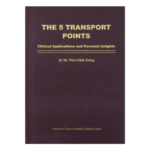 | Classical Theory · Clinical Application Quick Facts Author Dr Wei-Chieh Young Pages 430pp, vinyl-bound Language English Publisher American Chinese Cultural Center Edition 1st edition, 2013 ISBN 978-0-9779026-8-2 Translated by Michael Helme The five transport points — jing, ying, shu, jing and he — are among the most clinically significant points in classical acupuncture, found along each of the twelve meridian channels. Understanding them fully means understanding not just their locations but their theoretical underpinning: the five phases, qi movement, seasonal and hourly correspondences, and the principles that govern when and why each category of point is selected. The 5 Transport Points: Clinical Application and Personal Insights by Dr Wei-Chieh Young is the most comprehensive English-language study of this subject available. At 430 pages, it moves from foundational theory through to advanced clinical application — drawing on Dr Young's decades of practice and scholarship to produce a text that is as much about the depth of classical thought as it is about point selection in practice. What the book covers 01 The significance and defining characteristics of each of the five transport point categories across all twelve meridians 02 Their connection to five phase theory, qi movement and blood flow — the classical theoretical foundations 03 Seasonal and hourly point selection — the principles governing when each category of point is most appropriate 04 Spatial and temporal correspondences in classical point selection theory 05 Acupoint bleeding and specialised needling methods associated with the transport point system 06 Dr Young's personal clinical insights — bridging classical scholarship and contemporary acupuncture practice Who this is for Practitioners and advanced students with a solid grounding in TCM theory who want to deepen their understanding of classical point selection. This is a substantial text — at 430 pages it rewards serious study rather than quick reference. Particularly valuable for those with an interest in the classical foundations of acupuncture theory. | |
 | 中文版 · Classical Herbal Medicine · Shanghan Lun Chinese Title 伤寒论临床应用讲座 Shānghán Lùn Línchuáng Yìngyòng Jiǎngzuò — Lectures on the Clinical Application of the Shanghan Lun Quick Facts Author 杨维杰 (Dr Wei-Chieh Young) Pages 527pp, hard-cover Language Traditional Chinese Publisher American Chinese Cultural Center Edition 1st edition, 2017 ISBN 978-1-943744-03-9 The Shanghan Lun (傷寒論), written by Zhang Zhongjing around 220 AD, is one of the foundational texts of Chinese medicine — the source of the classical formula tradition that continues to inform clinical practice today. Studying it well requires both precise textual understanding and the clinical experience to translate that understanding into practice. This book distils over 40 years of Dr Wei-Chieh Young’s teaching on the Shanghan Lun into a systematic clinical reference. Written in Traditional Chinese, it covers six-channel pattern identification, formula analysis and clinical application — with sections on textual interpretation, pattern differentiation and comparative formula studies. At 527 pages, it is one of the most comprehensive modern works on the subject available in Chinese. What the book covers 01 Six-channel pattern identification (六经辨证) — the core diagnostic framework of the Shanghan Lun 02 Classical formula analysis — structure, composition and the principles governing formula selection 03 Textual interpretation of the Shanghan Lun’s original passages, with clinical commentary throughout 04 Pattern differentiation studies — comparative analysis of related presentations and the formulas associated with each 05 Practical guidance on applying classical Jing Fang formulas in a contemporary clinical setting 06 Over 40 years of Dr Young’s teaching and clinical insight, systematically presented for the first time in this volume Who this is for Practitioners and advanced students of Chinese herbal medicine who read Traditional Chinese and want to deepen their study of the classical formula tradition. A solid grounding in TCM theory and herbal medicine is assumed. This is a substantial scholarly text — best approached as a course of study rather than a quick clinical reference. | |
 | 中文版 · Tung’s Acupuncture · Colour Edition Chinese Title 董氏奇穴讲座 – 治疗学(彩色版) Dǒng Shì Qí Xué Jiǎngzuò – Zhìliáoxué (Colour Edition) Quick Facts Author 杨维杰 (Dr Wei-Chieh Young) Pages 261pp, hard-cover Language Traditional Chinese Publisher American Chinese Cultural Center Edition 2006 ISBN 978-0-9779026-1-7 This is the Traditional Chinese-language colour edition of Dr Wei-Chieh Young’s foundational text on Tung’s acupuncture — based on lectures delivered at Kyung Hee University and Semyung University in South Korea. It covers the same core material as the English-language Lectures on Tung’s Acupuncture: Therapeutic System, and is presented here in its original language with full-colour illustrations throughout. The text systematically explores the treatment principles and clinical applications of Master Tung’s acupuncture points. A distinctive feature of this edition is its comparative approach — drawing explicit parallels between Tung’s point system, classical meridian-based acupuncture and herbal prescriptions, providing practitioners with a broader integrative perspective on TCM practice. What the book covers 01 The treatment principles and clinical applications of Master Tung’s acupuncture point system 02 Point selection strategies and treatment methods across a range of clinical presentations 03 Comparative analysis of Tung’s points alongside classical meridian acupuncture and herbal medicine approaches 04 Full-colour illustrations throughout, supporting precise point identification and clinical reference 05 Dr Young’s original lecture material from Kyung Hee and Semyung Universities — in its source language Who this is for Practitioners and students who read Traditional Chinese and want to study Dr Young’s work in its original language. The colour edition adds visual clarity not present in the English text, making it a valuable companion volume even for those who also hold the English edition. |
List Layout
Filters Sort results
Reset Apply